

Guides › Leveling Guide
WoW Classic Hardcore Leveling Guide
Leveling in Hardcore is not about speed. The fastest path to 60 in normal WoW and the safest path to 60 in HC are completely different routes. This guide covers how to think about leveling when death is permanent.
By Marc · Updated July 27, 2026
The core principle: margin of safety
In regular WoW Classic, you fight mobs at or above your level for maximum XP efficiency. In Hardcore, that logic gets inverted. A mob that is two levels higher than you has a meaningful chance to critically hit you, resist your abilities, and outrun you if you try to escape. The XP bonus is not worth it.
The standard HC leveling principle is to fight mobs that are one or two levels below you. You lose maybe 20% XP per kill. In exchange, you get a much larger window to react if something goes wrong: a second mob wanders in, your connection stutters, you misread the situation. That window is what keeps characters alive.
Apply the same principle to zones. Move to a new zone when you are at the bottom of its recommended level range, not the top. Arriving at Stranglethorn Vale at level 31 when the zone opens at 30 means you are fighting mobs your own level or below. Arriving at 28 means you are fighting uphill the entire time.
Zone progression by level
WoW Classic zones have fixed level ranges. The following is a rough progression that keeps you fighting at or above the mobs rather than below them. Quests in earlier zones are worth completing before moving on, the XP per hour from a clean, known zone is often better than struggling in a new one.
Each race has a dedicated starting zone. Complete it fully before leaving. You will not return, and the quests are tuned for exactly your level. These zones have no meaningful risk for an attentive player.
Alliance: Westfall, Loch Modan, Darkshore. Horde: Northern Barrens, Silverpine Forest. These zones introduce wandering mobs and multi-pull risk for the first time. Learn to check your flanks before engaging.
Alliance: Redridge Mountains, Duskwood, Wetlands. Horde: Hillsbrad Foothills, Stonetalon Mountains. Duskwood has elite wandering creatures; Wetlands has a drake patrol that kills unprepared players at level 20. Know what is in a zone before entering it.
Arathi Highlands, Desolace, Dustwallow Marsh, early Stranglethorn Vale. Stranglethorn packs dense camps, patrols, and elites close together, and official Hardcore realms aren't PvP realms, so the danger here is PvE density rather than open-world ganking. Consider doing Desolace or Arathi first if you want a gentler transition zone.
Tanaris, Feralas, The Hinterlands, Badlands. These zones have fewer quests relative to their size, so you may need to supplement with dungeons. Tanaris is straightforward; Feralas has some difficult elite quests that are best skipped in HC.
Western Plaguelands, Eastern Plaguelands, Winterspring, Burning Steppes. The Plaguelands have a very high mob density and many undead that cast disease, draining your stats mid-fight. Fight carefully, body-pull conservatively, and never assume a room is clear.

When to do dungeons versus solo questing
Dungeons are the most efficient source of gear in the game, but they carry social risk that solo questing does not. You are dependent on four other players, and a bad pull or a disconnected tank can kill the entire group. Treat dungeon runs as a deliberate investment, not a casual activity.



Enter a dungeon when you are comfortably above the minimum recommended level for it. A dungeon designed for level 20–25 should be attempted at 23 or above if you want a meaningful safety margin. Ask the group about their experience before you start. A group of HC players who know the dungeon is a very different experience from a mixed group running it for the first time.
On official Hardcore realms, nearly all dungeons have at least a 24-hour lockout for characters below level 60, and a level 60 character cannot enter a lower-level dungeon together with a character below level 60. Plan repeat runs and mixed-level groups around this.
Key dungeon level windows for HC players:
- Deadmines (VC): levels 20–24 is the safe window
- Shadowfang Keep: levels 24–28
- Blackfathom Deeps: levels 26–30
- Stockades: levels 25–29 (very safe, recommended for HC)
- Gnomeregan: levels 30–36. Wait until you are 32+
- Razorfen Kraul: levels 32–38
- Scarlet Monastery: levels 35–45 depending on wing
- Uldaman: levels 42–50, one of the harder HC dungeons
- Zul'Farrak: levels 46–52
- Maraudon: levels 46–55. Avoid the early wings solo
Our Dungeon Guide shows the quest pickup locations for every dungeon on the world map, so you can plan where to grab quests before entering.
Common ways HC characters die while leveling
Most HC deaths while leveling come from a small number of repeating scenarios. Recognising these patterns in advance is the fastest way to survive them.
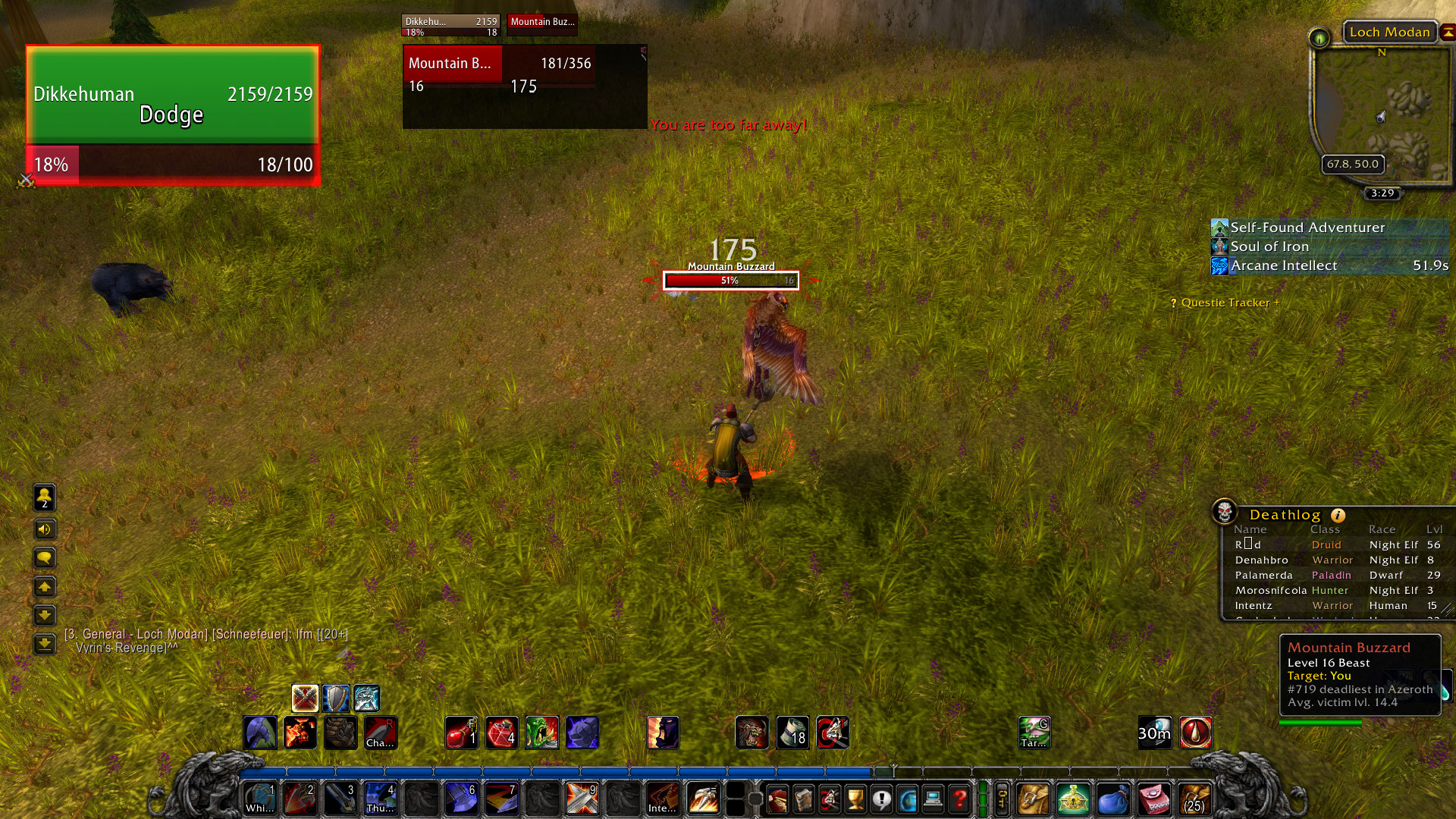
Pulling a fleeing mob into more enemies. When a mob reaches low health it runs. In Classic, mobs run in a straight line and aggro anything they pass through. If you are near a cluster of enemies, finish the mob before it reaches 20% health, or use a snare or stun to stop it before it flees.
Body-pulling sleeping or patrolling mobs. Walking too close to a mob that is not moving, one that is sitting still, sleeping, or at a point in its patrol, can aggro it silently. Give sleeping mobs a wide berth. Check patrol routes before committing to a fight in their path.
Drowning. WoW Classic's underwater zones and rivers are a genuine cause of death. Your character drowns faster than most players expect, especially when confused about the surface direction. If you need to swim through deep water, do it in short sections and surface often.
Fall damage. The game does not always telegraph how fatal a drop is. If you cannot see the ground, do not jump. Slow Fall (Mage), Levitate (Priest), and the Noggenfogger Elixir slow-fall effect are genuinely underrated HC utilities for the classes and consumables that have access to them.
Fighting while fatigued from being out of rest XP. This is not a mechanical danger but a psychological one. Long play sessions without breaks increase distraction and missed details. Take breaks. The character will still be there.
Not knowing when to run. Running in Classic can succeed if you start early enough, through slows, crowd control, breaking line of sight, and terrain knowledge, not because you universally outrun enemies. Use doorways, corners, and elevation changes to break line of sight and reset the fight, and don't assume you can simply outpace whatever is chasing you. The mistake is waiting until you are at 20% health before deciding to escape. Decide to escape at 50% if the fight is going wrong.
Gear while leveling in HC and Self-Found
In standard Hardcore, you have access to the Auction House and can buy gear from other players. In Self-Found, you cannot. This changes gear strategy significantly.
In Self-Found, your gear sources while leveling are: quest rewards, dungeon drops, vendor purchases, and crafted items from your professions. Prioritise picking up professions early. Mining and Blacksmithing, Mining and Engineering, or Herbalism and Alchemy are the most impactful profession pairs for Self-Found leveling. They provide craftable gear or consumables that meaningfully improve your survivability.
Do not ignore vendor gear. Classic WoW vendors sell functional armour and weapons at every major town. At level 20, a vendor-bought shield or chest piece might be better than what you have equipped from quests, especially if you have been unlucky with drops. Check vendors in new towns before assuming your gear is up to date.
Use the Gear Planner to see all gear ranked for your class, spec, and current level, including which items are legal for Self-Found and which dungeons they come from.
Class-specific leveling tips
The general advice above applies to every class, but each class has specific habits that significantly affect survival. These are the non-obvious ones.
 Hunter
Keep your pet fed at all times. A hungry pet loses damage and threat generation, which means more hits land on you. Before any difficult pull, check that your pet is at full happiness. Never let your pet die if you can avoid it, a dead pet in a dangerous spot means you absorb the damage yourself until you can resummon.
 Warlock
Do not treat Soulstone or Reincarnation as a safety net, neither can resurrect a character on an official Hardcore realm. Keep your Voidwalker as your default solo companion and let it hold aggro while you safely manage damage from range, but watch its threat against DoTs and direct damage.
 Druid
DruidTravel Form gives a faster movement speed for creating distance, but it's outdoors-only and can still be interrupted by daze, stuns, or fears. Shift immediately when something unexpected happens rather than waiting until you're at 10% health, and don't assume the speed boost alone guarantees you outrun whatever is chasing you.
 Paladin
Save Divine Shield for genuine emergencies, not for making fights faster or skipping trash. Every time you use the Bubble, it is unavailable for the next 5 minutes. In Hardcore, that 5-minute window where you have no emergency escape is the most dangerous period of your session. Use it to heal up, reposition, or walk to safety. Bubble Hearth is disabled on official Hardcore realms, so it buys time to retreat on foot, not to teleport out.
 Warrior
You have no reliable combat reset or immunity. This means your survival is entirely about not being in a dangerous situation in the first place. Pull one mob at a time. Use terrain to break patrols. Keep your consumables stocked, and lean on Hamstring, Intimidating Shout, and Berserker Rage (against Fear) when a pull goes wrong. Carry Healing Potions, Bandages, and a Rage Potion for desperate fights.
 Mage
MageNever stand in a corner or against a wall when Frost Nova is unavailable. Your safety depends on having space to run. Kiting is always an option if you start early. Begin moving the moment a fight feels like it is going wrong, not after you have used all your instants. Blink through walls can fail indoors; do not rely on it in tight spaces.
 Priest
Cast Power Word: Shield before every pull. It absorbs the first few hits for free and gives you time to react. Never let your mana pool drop below 30%. Without mana, you have no heals, no Fade, and no Psychic Scream. Eat or drink between every pull to stay topped up.
 Rogue
RogueSap the most dangerous mob before initiating any pull with multiple enemies. Sap requires Stealth, so approach carefully. Never fight two unsapped mobs at the same time unless you know exactly what you are doing. Vanish is your primary emergency escape, do not use it offensively for position resets, save it for when you genuinely need to leave combat.
 Shaman
Drop totems before every significant pull, not during it. They're instant casts, but they trigger the global cooldown, stay at a fixed spot, and can pull nearby mobs, so placing them reactively mid-fight leaves you exposed. Ghost Wolf (available at level 20) can be cast in combat outdoors (3-second cast, 1 second if talented) but not indoors. Use it to disengage from the edge of a pull before mobs reach you, not after.
Frequently asked questions
How long does it take to level to 60 in WoW Classic Hardcore?
It varies a lot by experience level, playstyle, and route, and takes noticeably longer than an optimised normal Classic run. The extra time comes from fighting mobs below your level, spending more time in known-safe zones, and stopping to assess situations before engaging. Rushing is one of the most common causes of HC deaths.
What are the most dangerous zones in WoW Classic Hardcore?
Stranglethorn Vale (dense camps, elites, and patrols packed close together), the Eastern and Western Plaguelands (very high mob density and disease debuffs), Gnomeregan (complex layout with many patrols), and Zul'Farrak (the pyramid event can overwhelm unprepared groups) are the most commonly cited dangerous areas for HC characters. Official Hardcore realms aren't PvP realms. PvP requires deliberately flagging with /pvp, so these zones are dangerous because of their PvE density, not open-world ganking.
What level should I be for Deadmines in WoW Classic Hardcore?
The safe entry window for Deadmines (Van Cleef) in Hardcore is level 20 to 24. Running it at 17 or 18 (the standard Classic recommendation) puts you below the mob levels and significantly increases risk. At level 22 or above, most of the dungeon is green or yellow difficulty, giving you a meaningful margin for error.
How do I avoid dying to fleeing mobs in WoW Classic?
Many humanoids and other enemies flee at low health, running in a straight line and aggroing anything they pass through, the exact threshold and behaviour varies by enemy rather than being a universal 20% rule. To prevent a chain-pull: burst the mob down before it flees, use a snare (Hamstring, Crippling Poison, Frost Nova, Concussive Shot) to stop it from running, or use a stun at the critical moment. Positioning yourself with a wall behind the mob limits its escape path.
More guides